A speech bubble whose tail turns into a shopping cart, printed in orange and indigo on a dark background
Illustration: AI-generated
AI & Technology · Black Friday

Black Friday 2026: AI assistants become the shop door

Americans are expected to spend $12.9 billion online today. More of them than ever will get to the checkout by asking a chatbot first.

How big is today?

US shoppers are forecast to spend $12.9 billion online on Black Friday, up 9.2% on last year's record $11.8 billion, according to Adobe's forecast. That makes today the second-biggest online day of the season, behind Cyber Monday on 30 November.

Adobe expects the five days from Thanksgiving to Cyber Monday to bring in $47.5 billion, and the whole season from 1 November to 31 December $275.1 billion, up 6.7%.

$12.9bn
Black Friday online sales forecast, +9.2%
$47.5bn
Cyber Week, Thanksgiving to Cyber Monday, +7.4%
+130%
Forecast growth in traffic from AI tools to US retail sites this season

Every big shopping day is forecast to beat last year

US online sales, $ billion: 2025 actual and 2026 forecast

How fast is AI traffic growing?

Last season, visits to US retail sites that came from generative AI tools such as chatbots rose 693% on 2024. On Black Friday 2025 alone they were up 805%. Adobe now forecasts another 130% rise this season, with Black Friday up 95% and Thanksgiving up 159%.

The percentages look smaller this year only because the base is so much bigger. Put the two years together and Black Friday AI traffic would be about 18 times its 2024 level.

AI-referred shop traffic heads for roughly 18 times its 2024 level

Visits to US retail sites from generative AI tools, indexed to 2024 = 1

vizmaya calculation from Adobe growth rates: season +693.4% in 2025 and +130% forecast for 2026; Black Friday +805% in 2025 and +95% forecast. Sources: Adobe, Jan 2026; Fox Business citing Adobe, 29 Nov 2025; Adobe forecast, Sep 2026.

Adobe reports these as growth rates, not as a share of all visits, so the chart shows how fast this channel is growing, not how big it is next to search, email or apps.

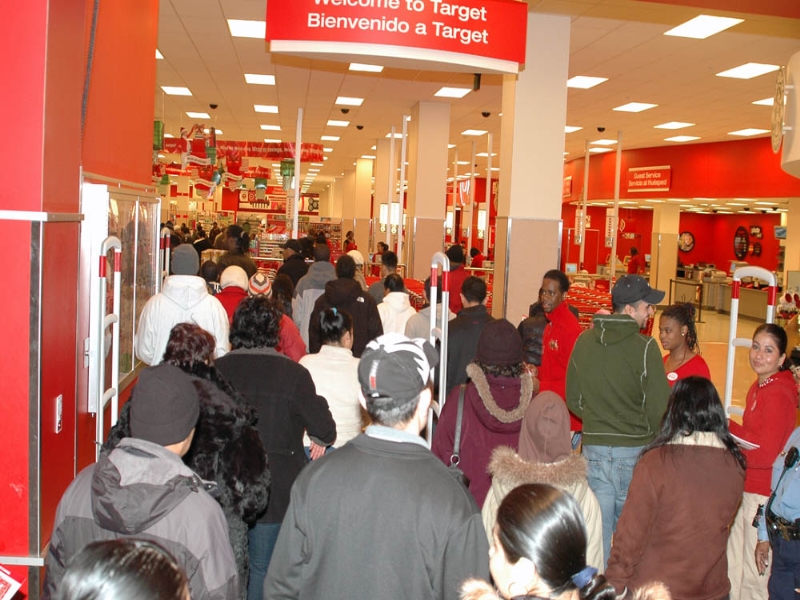
Shoppers crowd inside a Target store in Washington, DC, early on Black Friday morning in 2008
The old front door: Target at DC USA, Washington, at 6:27am on Black Friday, 28 November 2008. Photo: Gridprop / Wikimedia Commons, public domain.

Where do people shop from now?

The doorbuster queue has not gone, but the phone has taken over. Adobe expects a record 63% of Thanksgiving Day's online spending, $6.9 billion in all, to happen on smartphones, and 57.4% across the season.

Buy now, pay later is growing alongside: Adobe forecasts $21.3 billion of it this season, with $807 million on Black Friday and $1.09 billion on Cyber Monday, 82% of it on mobile.

The question for 2026 is not whether shoppers ask a chatbot. It is whether they let it pay.

Can an AI assistant actually buy for you?

For the first time, some can, but only in a few places and with the shopper still pressing the last button.

The reports do not all agree. A consultancy, Bundl, writes that OpenAI scaled back in-chat checkout in March, which sits awkwardly with IBM's account, so treat the list as a snapshot of what was reported this week rather than a settled map.

And most shoppers are not ready to hand over the card. Deloitte found that only 16% of US shoppers would let AI complete a purchase, as cited by IBM.

Are the deals any better?

No. Adobe's forecast of the deepest discounts this season is almost exactly last year's: about 30% off electronics, 29% on toys and 23% on TVs, computers and clothes. What has changed is how shoppers hunt for them, not how big they are.

Peak discounts are flat on last year

Deepest expected discount off listed price, %: 2026 forecast, with 2025 as the grey tick

That makes the assistant's answer only as good as the price data behind it. Jeannie Marie Paterson, a law professor at the University of Melbourne, warned in The Conversation this week that a chatbot's "great deal" may not exist, and that commercial partnerships can shape which products it recommends.

Adobe's figures above are forecasts made in September. Its first tallies of what was actually spent come out over the next few days, and the AI numbers are the ones to check.
Sources & method