India's Delimitation Bill: every state gets 50% more MPs, so nobody gets more of anything.
On Friday 27 November the Union Cabinet reportedly cleared a revised plan for India's Lok Sabha: half as many seats again for every state and union territory, and each one's share frozen until 2051. Parliament sits again on Monday to try it. It is a reform built so carefully that nothing changes except the size of the room, and the number of chairs that have to be cut in half.
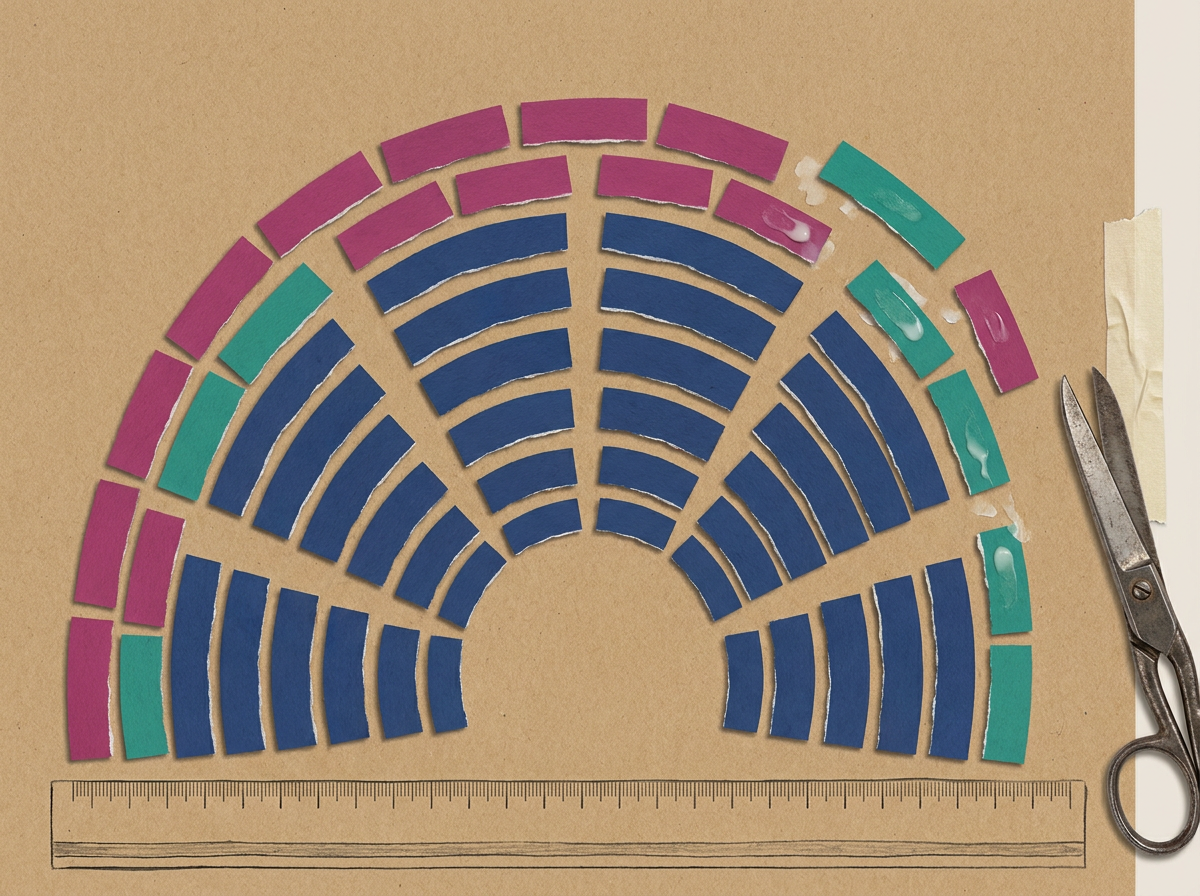
543 seats, plus 50%, equals somewhere between 805 and 850. Depending on who's counting.
The Lok Sabha has 543 seats. Add 50% to each state's count and you get 814.5 in total, which is the first of several half-MPs in this story.
The reports have not agreed on the answer either. The Federal put the total at 850 on Friday and at "around 816" on Saturday. If every half seat is rounded up, our own count of the current seats gives 824. Rounded down, 805. The one document that settles it, the bill's text, we could not find published.
850 was also the total in April's failed version of the plan, so it may be a leftover. The cabinet approval itself is reported, not officially announced: Newsgram notes the government had not confirmed its agenda.
Four answers to one sum
Seats in the Lok Sabha. The 805–824 range is our arithmetic on the current state-wise seats; the bill's rounding rule is not public.
The first draft didn't survive April. This one has had a haircut.
In April the government brought a Constitution amendment, the 131st, with a delimitation bill to take the house to 850 seats and let the redrawing start before the 2027 census, which would speed up one-third reservation for women. It fell short of the two-thirds majority a constitutional change needs, against a united opposition that objected to tying delimitation to the census.
The November version drops the arithmetic argument entirely. Everyone gets the same 50%. Nobody's share moves. It is the political equivalent of ordering a bigger pizza so that nobody has to discuss the slices.
The women's reservation link survives: Open magazine reports the constitutional amendment is still meant to implement the 33% quota in legislatures.
Same goal, different maths
Sources: Wikipedia (citing News On AIR), Open magazine, The Federal, Newsgram.
The south's big win is a share that barely moves: 7.18%
The five southern states, Andhra Pradesh, Karnataka, Kerala, Tamil Nadu and Telangana, hold 129 of the 543 seats, or 23.76%. Their fear was a count based on today's population, where their slower growth would cost them seats. A flat 50% takes them to 195 and keeps the share where it is, give or take a rounding error.
Tamil Nadu's demand was a single number: keep its 7.18% of the house. DMK's A Raja says the new plan takes it to 7.21%. So after months of argument the headline gain is three hundredths of a percentage point. Decimals are the new battleground.
Amit Shah gave the 129-to-195 figure in April, with a share of 23.87%. On our count 195 of 824 is 23.67%. The gap is the rounding again.
Tamil Nadu's share, measured to the hundredth
Share of Lok Sabha seats. Yes, the bars are nearly identical. That is the point of the bill.
19 states and union territories now need half an MP
Of India's 36 states and union territories, 19 send an odd number of MPs. Add 50% and each lands on a half. Tamil Nadu gets 58.5. Delhi gets 10.5. Mizoram, Nagaland, Sikkim, Puducherry and four other places with one seat each get one and a half.
Someone has to decide whether that half becomes a whole MP or nobody. Telangana's KT Rama Rao says his state goes from 17 to 26, which suggests rounding up, at least for Telangana. Round every half up and the house ends at 824, nine and a half seats more than a straight 50% would give.
The rounding rule is our open question, not a reported controversy. The answer is presumably in the bill's text, which we could not read.
Half the map ends in .5
One square per state or UT, largest delegation first. Full list in the table at the end.
Uttar Pradesh's 40 new seats are twice all of Kerala's
Equal percentages are not equal seats. Uttar Pradesh goes from 80 to 120, so its new seats alone outnumber Kerala's entire delegation of 20 two to one. Maharashtra gains 24, West Bengal 21, Bihar 20. Lakshadweep gains half a person.
Nobody's share changes, which is why nobody is complaining about this part. It is just a reminder that "fair" and "the same" are cousins, not twins.
These are the current seats times 1.5, our arithmetic on the reported rule. Final numbers wait on the bill's text and the Delimitation Commission it would set up.
The ten biggest delegations, before and after
Dark: seats now. Light: the added 50%. Seats, before any rounding.
The opposition, now available with a sub-opposition
The bill needs two-thirds of the members present and voting in both houses. In April the opposition voted as one. This week it is voting as several. As of Saturday, the DMK, YSR Congress and the BRS said they would support the new plan, and the NCP (Sharad Pawar) was reported to be on board too.
Congress and several INDIA bloc allies have said they will oppose it. The CPI and CPI(M) are against it in its current form. The BJD and Jharkhand's JMM had not decided. And the Trinamool Congress has managed to be on both sides at once: the Mamata Banerjee-led faction is expected to vote no, while a breakaway faction sits with the NDA.
Positions as reported by The Federal on 28 November and Open magazine on 27 November. They may have moved since. Several were "sources say", not statements.
Where parties stood on Saturday
Support
- DMK
- YSR Congress
- BRS
- NCP (SP), reported
Oppose
- Congress and INDIA allies
- CPI, CPI(M)
- TMC (Mamata faction), expected
- AAP, hinted
Undecided
- BJD
- JMM
- Shiv Sena (UBT): "won't bow to pressure", which is not a vote
Sources: The Federal (28 Nov), Open magazine (27 Nov).
A "temporary" freeze, now entering its sixth decade
The shares being frozen were set on the 1971 census. In 1976 the 42nd Amendment froze them until after the 2001 census. In 2002 the 84th Amendment pushed that to after the first census taken after 2026. The new plan, as reported, keeps the proportions until 2051.
By then the seat shares will be 80 years older than the population count they came from. In Indian constitutional law, "temporary" is a unit of time roughly equal to a career.
The 2051 date is from the reports of the revised bill, not from published text.
Each freeze ends with another freeze
Years the seat shares are frozen. The last band is hatched: proposed, not law.
The bill, by the numbers nobody can round
seats today, unchanged in size since the 1970s
Lok Sabhamore seats for every state, so equal it hurts
The Federal, Openstates and UTs left holding half an MP
Our arithmeticwhen the freeze would thaw, unless it doesn't
Newsgram, Open