

The through-line
Farmers, merchants and settlers all moved in and out of Anatolia. Silver and tin moved too. But the thing that changes hands along this route is the pen. Every place has a record, and someone chose to write it. That someone changes from place to place.
Eight places, 9,000 years: the writing only shows up late
Dates from the claims log (C1, C5, C6, C8, C15, C17, C20, C24, C27, C28). Bars show ranges as given by sources. Ephesus dates are argued.
The route: seven places inside Türkiye, in story order
Lines join places in story order. They are not travel routes. Coordinates are approximate and come from the desk's own knowledge, not a cited source. Map: Natural Earth via world-atlas.
Insider voice
A scholar from inside
Çiğdem Atakuman of Middle East Technical University in Ankara studied how archaeology was used in the early Republic, 1923 to 1938. She argues the 1930s history thesis shaped Turkish archaeology from the start. Digs were meant to show Anatolia was Turkish since prehistory.
We read the abstract only. METU record.
The route table
| # | Place | Modern country | Lat, Lon | Era | What happened or what is there | Source | Status |
|---|---|---|---|---|---|---|---|
| 1 | Çatalhöyük, Konya Plain | Türkiye | ~37.67, 32.83 | c. 7000 to 6000 BCE | A farming-town mound near Çumra, still dug today. Its ancient DNA matches the first farmers who spread into Europe. Not proven to be a departure point. | Kılınç et al. 2016; Hofmanová et al. 2016 | Inferred |
| 2 | Yenikapı, Istanbul | Türkiye | ~41.00, 28.95 | c. 6000 BCE; ships 400s to 1000s CE | A transit hub today. A subway dig found an 8,000-year-old village and a harbor with 37 ships. | Istanbul Archaeological Museums, Koç University Press, 2013 | Documented |
| 3 | Kültepe (Kanesh), Kayseri | Türkiye | ~38.85, 35.63 | c. 2000 to 1750 BCE | The quarter where merchants from Assur lived. About 23,000 tablets: letters, loans, debts. On Türkiye's UNESCO tentative list. | UNESCO tentative list; Larsen; Michel | Documented |
| 4 | Hattusa (Boğazkale), Çorum | Türkiye | ~40.02, 34.62 | c. 1650 to 1200 BCE | The Hittite capital. World Heritage site since 1986. More than 30,000 tablets, now in several museums. | Çorum Directorate of Culture and Tourism; Hoffner | Documented |
| 5 | Hisarlık (Troy), Çanakkale | Türkiye | ~39.96, 26.24 | c. 1400 to 1200 BCE | A mound on the Dardanelles with at least ten layers. Hittite tablets name a place called Wilusa. Most link it to Troy. How closely it fits Homer is argued. | Archaeology magazine; EIU Historia paper, 2017 | Contested |
| 6 | Ephesus and Ionia, Selçuk, İzmir | Türkiye | ~37.94, 27.34 | Dates argued: c. 1200 to 900 BCE | A big archaeological site. Greek settlers arrived on a coast already home to others and formed a league of twelve cities. | World History Encyclopedia; Herodotus 1.142-148 | Contested |
| 7 | Museum of Anatolian Civilizations, Ankara | Türkiye | ~39.94, 32.86 | 1921 to 1930s CE | Began as a Hittite museum at Atatürk's suggestion. In the 1930s a state history thesis made the Hittites Turkish ancestors. | Ministry of Culture brochure; Atakuman; Erimtan | Documented |
Status key: Documented means sources agree. Contested means sources disagree or the link is argued. Inferred means we read it from indirect evidence.
Fact, our reading, a guess
Fact: the Kanesh tablets exist, and the 1930s thesis was written.
Our reading: calling the merchants' silver payments "ancient remittances" is our own label. The tablets record loans and trade, not a category called family transfers.
A guess: one scholar argues the state liked the Hittites because they came before Islam and the Ottomans. We did not test that.
What we could not find
- Any money numbers from the deep past. "Remittances" before 1000 CE is an analogy.
- The local side of Kanesh. Anatolians speak to us through the merchants' tablets.
- The UN and TurkStat emigrant counts, checked at source. We left them off the page.
- Photo authors and licences. Commons was unreachable when we built this page, so they are still to be confirmed. A Yenikapı photo is also missing.
1 · 7000 to 6000 BCE · Inferred
Çatalhöyük: the first farmers on the move


About 9,000 years ago farming reached Europe. DNA shows the first European farmers shared a gene pool with people in central Anatolia. This is the oldest "leaving home" story here. It has no letters and no money. Only bones.
2 · c. 6000 BCE to 1000s CE · Documented
Yenikapı: one shore, 8,000 years
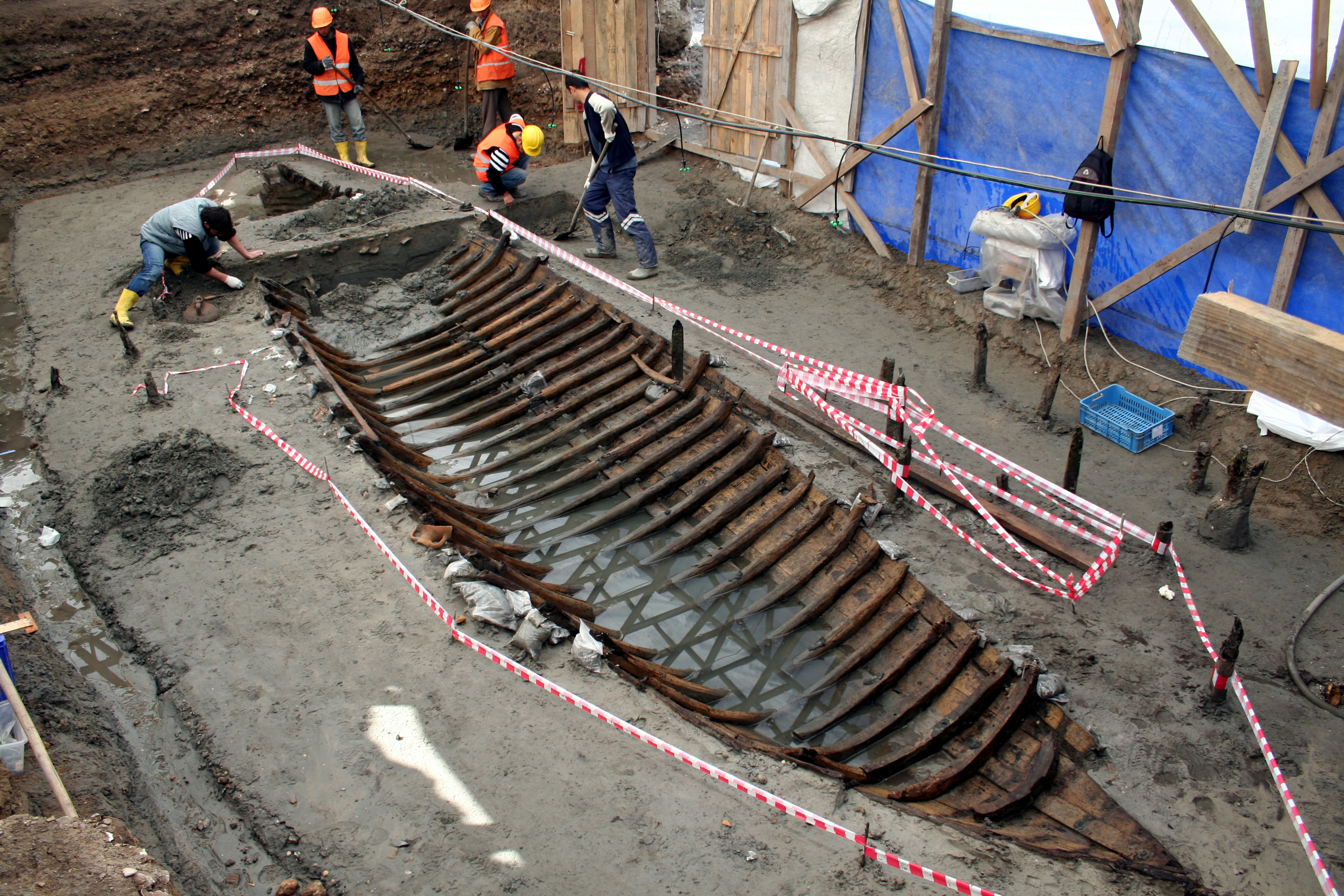
A subway tunnel dig in Istanbul hit a village about 8,000 years old, with around 2,000 footprints. Above it sat a harbor with 37 ships from the 5th to the 11th century. People have crossed here for a very long time.
3 · c. 2000 to 1750 BCE · Documented
Kültepe: the first writing is a migrants' mail


Merchants from Assur, in what is now Iraq, lived in their own quarter here. They wrote letters to family, loans and debt notes on clay. Silver and gold went one way. Tin and textiles came the other.
4 · c. 1650 to 1200 BCE · Documented
Hattusa: then the locals' own archive


The Hittite kings kept more than 30,000 tablets: treaties, letters, laws. The first big dig, in 1906, was led by a German scholar with an Ottoman museum official.
5 · c. 1400 to 1200 BCE · Contested
Troy: two versions of one place

.jpg)
Greek poetry says Troy. Hittite letters name a nearby place, Wilusa, and a sea people called the Ahhiyawa across the water. Most scholars link Wilusa to Hisarlık. How well Homer fits is still argued.
6 · c. 1200 to 900 BCE (argued) · Contested
Ephesus: Greeks settled, and Greeks told it


Greek settlers moved to this coast and formed a league of twelve cities. Sources disagree on when, from about 1200 to the 900s BCE. Our main written source is Greek: Herodotus.
7 · 1921 to the 1930s · Documented
Ankara: the state picks the Hittites


In 1921 a Hittite museum began here at Atatürk's suggestion. In the 1930s a state history thesis said Turks were native to Anatolia and that the Hittites were Turks. That thesis is documented. Its claim is disputed.
How to read the labels
Documented sources agree.
Contested sources disagree, or the link is argued.
Inferred we read it from indirect evidence.
Contested is not "false". It means the honest answer is "both sides have a case".
Money sent home to Türkiye fell by more than half from 2014 to 2025
In 2024 people abroad sent 982 million US dollars to Türkiye. Our reading: this is small, so the story here is about records, not cash.
Source: World Bank, personal remittances received (current US$).
23,000
clay tablets from Kanesh. Counts run from 22,500 to 23,500.
UNESCO tentative list; Larsen; Michel
31,519
tablets from Hattusa, now spread across several museums.
Çorum Directorate of Culture and Tourism
37
ships found at Yenikapı, from the 5th to the 11th century.
Istanbul Archaeological Museums, 2013
7.5 million
Turkish citizens abroad in 2024, per the Foreign Ministry. Contested The count was about 5 million in 2019, and outlets use different totals.
Turkish Minute; Hürriyet Daily News
Kültepe, then and now
Then · about 1900 BCE
- Merchants from Assur, in what is now Iraq, live in their own quarter.
- They write home about silver and copper loans and debts paid off.
- They carry in tin and textiles, and carry out silver and gold.
- A fire around 1836 BCE destroyed the city and preserved the tablets.
Now · Türkiye
- A mound about 20 km northeast of Kayseri.
- Dug without a break since 1948. Fikri Kulakoğlu of Ankara University has led it since 2006.
- On Türkiye's UNESCO tentative list. That entry calls the tablets the first written documents of Anatolia.
- Letters from wives in Assur show women running family business at a distance.
Sources: UNESCO tentative list; Metropolitan Museum of Art; Brepols (Subartu 35); Michel, Women of Aššur and Kaneš.
The state's story and the scholars' story
The 1930s state version
- Turks are native to Anatolia and have been there since prehistory.
- They carried civilization out of Central Asia.
- The Hittites were Turks.
- State digs began in 1933 to show this.
What scholars say
- Large Turkic settlement of Anatolia follows 1071, more than 2,000 years after the Hittite capital.
- The "Hittites were Turks" idea came from a selective reading of 19th-century European writing.
- Byzantium had contact with Central Asian Turks from the 6th century. That is contact, not settlement.
- Turkish scholars such as Atakuman study the thesis critically.
Sources: Atakuman (METU); Erimtan (Cambridge); Metropolitan Museum Timeline of Art History; Cambridge History of Islam.
Hero insight
The oldest written records known from Anatolia are a foreign diaspora's business letters. Türkiye's own UNESCO filing says so, while the 1930s state history claimed the Hittites as Turkish ancestors instead.
About 23,000 tablets about silver, debts and family, written by merchants far from home. Turkish excavators have dug them since 1948.
Backed by claims C9, C10, C11, C14, C25 and C26.
Sources and claims log
33 claims logged. 25 verified, 3 contested, 5 left off the page because we could not check them well enough. Photos: seven from Wikimedia Commons, each linked to its file page. Authors and licences are still to be confirmed. The Yenikapı slot is empty.
- UNESCO: Kültepe-Kanesh, tentative list
- Metropolitan Museum: Kültepe tablets
- Çorum Directorate of Culture and Tourism: Hattusa
- Istanbul Archaeological Museums: Yenikapı
- Kılınç et al. 2016, Current Biology
- Erimtan: Hittites, Ottomans and Turks
- Metropolitan Museum: Anatolia and the Caucasus, 1000 to 1400
- World Bank remittances series
- More stories on vizmaya
Left off the page: UN DESA emigrant and immigrant counts (seen only on relay sites), the Alaksandu treaty date, and two single-source language claims.
Who tells the story of Anatolia?
This is a trail through seven places in Türkiye. People and silver move along it. The real question is who got to write it down.
The first writing was letters home
About 4,000 years ago, merchants far from home wrote about silver, debts and family. Those tablets are the oldest written documents known from Anatolia.
Seven places, one route
Each marker shows how sure we are. Filled means documented. Ring means contested. Diamond means inferred.
The route table
Every place has a date, a source and a status. The coordinates are approximate.
First, farmers and a shore
DNA ties central Anatolia to Europe's first farmers. At Yenikapı, people have used the same shore for 8,000 years.
Kültepe: a diaspora writes home
Merchants from Assur lived here and wrote on clay. Their letters, loans and debts are the earliest writing we know from Anatolia.
The locals' archive, and a disputed city
The Hittites kept their own archive. Hittite letters also name Wilusa, which most link to Troy. Homer's version is argued.
Settlers write, then the state writes
Greek settlers are known mostly through Greek writers. Then the new Republic picked the Hittites as its ancestors.
Two stories, side by side
The 1930s state version and the scholars' version differ. Turkish scholars are part of the second one.
See it on a timeline
Writing shows up late. Large Turkic settlement of Anatolia starts after 1071, long after most of these places.
The numbers
Tablets, ships and a small, falling stream of money sent home. One count is contested.
The finding
The first written words of Anatolia are a foreign diaspora's letters. The state chose a different story.
What is fact, and what is missing
Facts, our reading and a guess are kept apart. The gaps are listed too.