Risograph-style illustration in gold and blue: a giant brass control lever on a dashboard, its cable running to a small city half hidden in fog
Illustration: AI-generated

Landmark Desk · Economics 1976

Milton Friedman’s Nobel: money matters, and it is hard to aim

The 1976 prize rewarded evidence that monetary policy moves the economy, and research on why that power does not make fine-tuning easy. Every central bank still lives with both halves.

vizmaya desk · 5 November 2026

Prize in Economic Sciences in Memory of Alfred Nobel, 1976

“for his achievements in the fields of consumption analysis, monetary history and theory and for his demonstration of the complexity of stabilization policy”
Prize motivation for Milton Friedman, sole laureate, announced 14 October 1976. The citation names fields, not a single winning publication.

One citation, three strands of work

  • Consumption analysisHow households spend: the permanent-income model in A Theory of the Consumption Function (1957).
  • Monetary history and theoryWhat money did across a century: A Monetary History of the United States, 1867–1960 (1963), written with Anna J. Schwartz, plus his money-demand studies.
  • Complexity of stabilization policyWhy policy is hard to steer: expectations and delays in “The Role of Monetary Policy” (1968).

InterpretationThis mapping of the citation to the readings is vizmaya’s, not the Academy’s words. Sources: prize motivation; Nobel press release, 1976.

The work

A Theory of the Consumption Function (1957)

The Nobel retrospective singles out this book, with the monetary history written with Schwartz, as Friedman’s key empirical work. Princeton University Press published it; NBER offers the theory chapter and the evidence chapter free.

Our brief began from Essays in Positive Economics (1953), a representative work. The award documents do not name it, so this page follows the book they do.

Black and white photograph of Milton Friedman in 1976, in a suit and tie, looking past the camera
Milton Friedman in 1976, the year of the prize. Photo: Eddie Adams / Wikimedia Commons, public domain

The one result

Spending follows the income you expect to keep

Friedman split a household’s measured income into a permanent part, the resources it expects to sustain, and a transitory part, this year’s windfalls and shortfalls. Neither is observed directly (Chapter III, pp. 20–23).

His model ties consumption to permanent income and treats the transitory parts as noise around it (pp. 23–26, equations 3.3 to 3.6).

Illustration: a small house fed by a wide steady gold river, while small blue clouds drop brief scattered rain around it
The river is permanent income; the passing showers are transitory. Illustration: AI-generated

A windfall moves income, not the spending trend

In the model, a one-off bonus or a bad year jolts measured income, while spending keeps tracking the steadier permanent line.

So comparing short periods can show spending reacting far less to income than the long-run average suggests.

SchematicMade-up numbers to show the mechanism in Friedman’s Chapter III, pp. 20–26. Not data.

Spending held near 90% of income. Its fitted slope swung from 0.45 to 0.87.

Nine overlapping United States cases, 1897 to 1949. APC is the average share of income spent; MPC is the regression slope. The gap is widest in 1929 to 1941: 0.94 against 0.45.

Rebuilt from Friedman’s own table: A Theory of the Consumption Function, Ch. V, Table 12, p. 126, rows 6–14, consumption concept ND. Periods overlap; these are fitted associations, not causal effects. Friedman warns a good aggregate fit is weak evidence on its own (p. 119).

Illustration: a classical bank facade with a stack of banknotes shrinking step by step like a staircase going down, under a dark sky
Illustration: AI-generated

Monetary history

Money mattered in the Great Depression

In A Monetary History of the United States, 1867–1960 (1963), Friedman and Anna J. Schwartz traced money across a century of United States history.

In 1968 Friedman summed up one conclusion: Federal Reserve action or inaction let a monetary contraction deepen the Depression of 1929 to 1933 (“The Role of Monetary Policy”, p. 3).
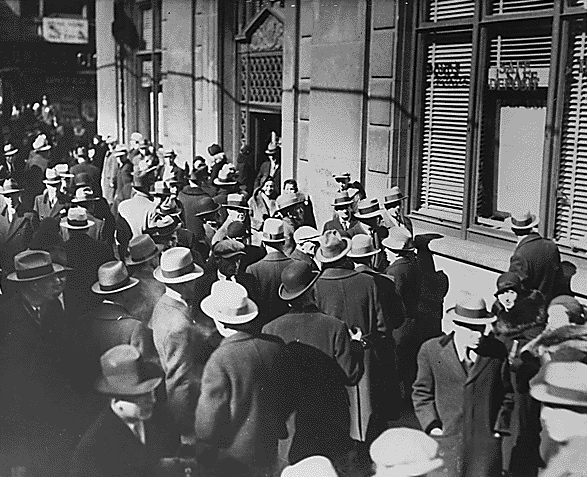
Crowd of people gathered outside a bank during a run on deposits in Michigan, February 1933
Bank run, Michigan, February 1933. Wikimedia Commons, public domain

Stabilization, part one

A boost that fades once people expect it

In “The Role of Monetary Policy” (1968), Friedman argued easier money can lift employment in the short run. Once people come to expect the higher inflation, that gain does not last (pp. 7–11).

Illustration: a hot air balloon lifted by a burst of flame, with a dotted path drifting back down to its old height
Illustration: AI-generated

SchematicShapes follow Friedman’s argument, pp. 7–11. No numbers; not data.

Illustration: a ship's wheel on a dock tied by a long rope to a distant cargo ship that is only beginning to turn, with an hourglass beside the wheel
Illustration: AI-generated

Stabilization, part two

Policy works late, and by a varying amount

Friedman argued that monetary policy takes effect after delays that vary, so a central bank steering by today’s data can push at the wrong moment. His remedy was a steady rate of money growth (pp. 14–17).

By 1976 the rewarded research was 8 to 28 years old

Eight publications behind the citation’s three strands, in calendar years before the prize. The consumption book was 19 years old; the monetary history, 13.

Years = 1976 minus publication year. Publication records: AER, NBER, Journal of Political Economy, Hoover Institution archive, Nobel lecture bibliography p. 285. An era-wide comparison was dropped: no comparable “first key work” exists for every 1970–89 laureate.

Why it won Interpretation

The common thread: don’t read the short run literally

One warning runs through all three strands. Current income need not measure what a household can sustain. An early jump in employment need not survive once expectations catch up. A policy decision need not take effect when the policymaker wants (pp. 20–26; 1968, pp. 7–11, 14–17).

What the motivation leaves out: Schwartz’s share of the monetary history, and any verdict on Friedman’s money-growth rule. It rewards a demonstration of complexity, not a prescription. The committee’s deliberations are not public; this reads the record, not its reasoning.

Illustration: a cracked magnifying glass over an open ledger, the crack splitting the magnified view into two slightly different images
Illustration: AI-generated

Where it breaks, part one

Spending reacts to cash in hand more than the simple model says

  • An unseen quantityPermanent income is never observed, so every test depends on how it is measured, and an aggregate fit cannot isolate cause. Friedman says as much (pp. 116, 119).
  • The 2001 rebatesJohnson, Parker and Souleles (2006) used the random timing of United States tax rebates: households spent 20 to 40% on nondurables in the three months of receipt, more where income or liquid wealth was low.
  • Not a full rejectionCarroll (2001) finds models with income risk and precautionary saving closer to Friedman’s original account than later simplified versions. The rebate study tests timing; it does not replicate his regressions.

Where it breaks, part two

Money is not the whole story, and a rule is not proven

  • Credit, tooBernanke (1983) added the collapse of credit intermediation to the Depression story, as a complement to Friedman and Schwartz. Contestedwhether money alone explains it.
  • The ruleBordo (2026) describes unstable money demand as a challenge to monetarism. Delays show policy is hard to time; they do not by themselves prove a fixed rule. Contestedwhether constant money growth is best in every regime.
  • No retraction foundThe records searched showed no formal retraction of the consumption evidence. That is a limit of the search, not a certificate.

Go further

Credit: Prize data: Nobel Prize Outreach AB (api.nobelprize.org, CC0). Work metadata: Open Library. The motivation is quoted verbatim. Laureate page · Open Library work

Sources and claims log

30claims logged
26verified
2contested
2unverified, off page

Every claim here traces to a verified row: the award record and API, the 1976 press release and Nobel retrospective, Friedman’s own texts (cited by page), NBER and journal publication records, and four later peer-reviewed or Federal Reserve studies.

Contested: that money alone explains the Depression; that a constant money-growth rule is best in every regime.

Not found or not done:

  • The scientific background page returned errors, so it is not used as evidence.
  • The full text of A Monetary History was not inspected.
  • Table 12 was transcribed, not recomputed.
  • No comparable “first key work” for every laureate of the era, so no era-wide lag chart.

Photos: Milton Friedman 1976, Eddie Adams, public domain; Bank run in Michigan 1933, public domain; both via Wikimedia Commons. Six illustrations (lever, river, banknotes, balloon, ship, magnifying glass): AI-generated with Magnific, illustration only, not evidence.