

The trail: six places in Peru, in the order the story happens
| Step | Place | Country today | Map position (about) | When | What happened here | Where we read it | How sure are we? |
|---|---|---|---|---|---|---|---|
| 1 | Callao (the port of Lima) | Peru | -12.05, -77.14 | 1849 to 1874 | This is most likely where the workers first stepped off the ships. Our sources only say "Peruvian ports", and just one US report names Callao, so we are guessing a little here. The workers signed contracts in China that lasted eight years, and owners often made them work longer [12]. About 100,000 people came to Peru this way [1]. We did not check what the port looks like today. | Rodríguez, Allpanchis; Brown Univ. Library | Our best guess |
| 2 | Chincha Islands | Peru | -13.63, -76.40 | 1840s to 1874 | Guano is bird droppings. In the 1800s it was sold around the world as fertilizer, and it made Peru rich for a while. Chinese workers dug it, and they also worked on farms and built railways [22]. Today the islands are a protected nature reserve, but a government agency still collects guano there. In its 2022 count, one of the islands had 472,075 guano birds [8]. | Andina, 2022; SERNANP RP 187-2020; Asian Review of Books | Well documented |
| 3 | Pativilca valley (Araya farm, Barranca) | Peru | -10.70, -77.76 | September 1870 | Chinese workers on the Araya farm rebelled, and the revolt spread across the valley. About 100 rebels grew to 1,200 to 1,500 in twelve hours. Government troops then killed roughly 80 to 130 people [11]. We did not check what is there today. | Rodríguez, Allpanchis, citing El Comercio, 7 Sept 1870 | Well documented |
| 4 | Lurín valley | Peru | -12.28, -76.87 | 11 January 1881 | Peru was at war with Chile. In Chilean accounts, 400 to 1,000 Chinese men met at a shrine to Guan Yu (a Chinese hero) and swore an oath. Chilean writers said it showed loyalty to Chile. Historian Heidi Tinsman reads it differently: as men promising to stand together against forced labor [13]. We did not check what is there today. | Tinsman, AHA abstract; Wikipedia, Quintín Quintana | Disputed |
| 5 | Cañete valley (San Luis de Cañete, Cerro Azul) | Peru | -13.05, -76.40 | February 1881 onward | Many Chinese farm workers were killed. Estimates run from about 500 to 1,500, and the accounts disagree about who did it and why [14]. According to Tinsman, one historian searched Chilean government files for the massacre and found no document about it. | Tinsman, 2019; Rodríguez, Allpanchis | Disputed |
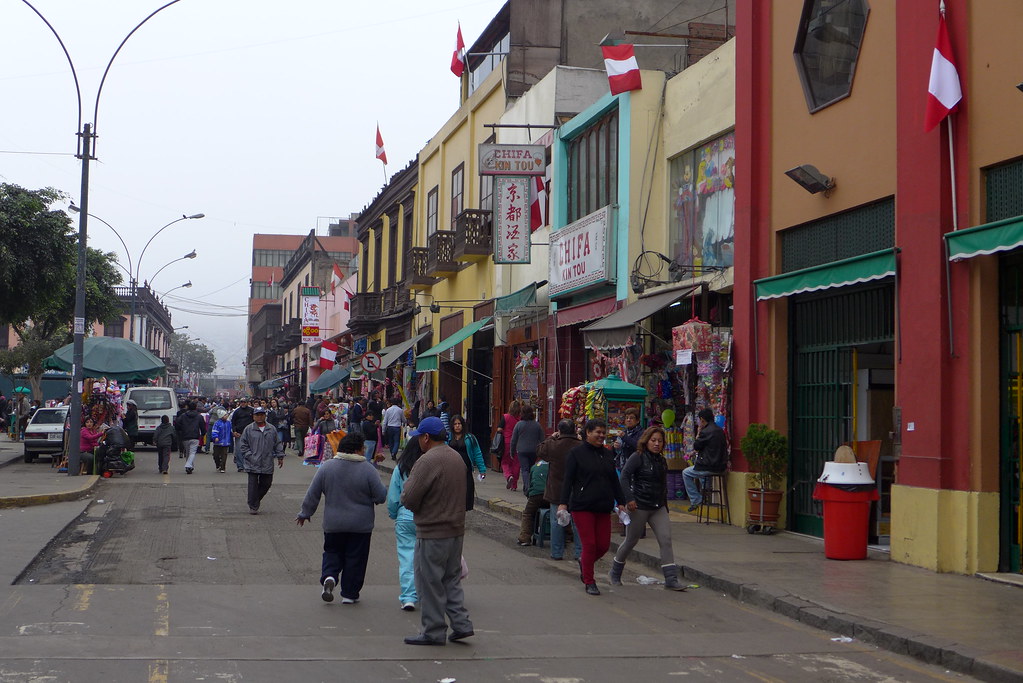
| 6 | Barrio Chino, Capón Street (Lima) | Peru | -12.05, -77.02 | 1854 to 1981 | A big market opened here in 1854, and Chinese shops appeared almost right away [16]. In May 1909 the mayor ordered a small alley knocked down, and a Chinese community group helped the families move close by [17]. Shopping arcades were built between the 1960s and 1981 [18]. | Lima municipal book; PUCP repository | Well documented |
The numbers in brackets point to our fact-check list. Map positions are rough. The lines join the places in story order. They are not the real sea or road routes.
The story in short
Starting in 1849, about 100,000 people were signed up in China to work in Peru [1]. Each signed an eight-year contract [12]. They dug guano, laid railway track and worked on farms [22]. In 1881, during a war between Peru and Chile, the Chileans, the Peruvians and the Chinese workers each told a different story about what happened to them [13, 14]. Then in 2017, Peru asked people about their ethnic background for the first time, and Chinese Peruvians had no box of their own [19].
The big finding
Peru brought in about 100,000 Chinese workers, and it was legal. But in 2017, the first time Peru let people choose their own ethnic group in a census, people of Asian descent got no box. Meanwhile, a Lima city book says 1 in 10 Peruvians has Chinese ancestry.
The "1 in 10" is an estimate, not a head count. [1, 19, 20]
The trail on a map: port, islands, valleys, capital
Source: positions from the trail table (rough). Land shapes: Natural Earth, via world-atlas.
Chincha Islands
These islands were the main source of guano during the boom [8]. Historian Paul Gootenberg found that the Peruvian state and the companies working for it kept 71% of the money from final sales [5]. Peruvian historian Jorge Basadre called the boom a "fictitious prosperity", meaning it looked rich but was not [6]. Records of how tall people grew also show that most Peruvians did not live better [7].
Well documented
Pativilca, 1870
The workers knew what their contracts said. Historian Humberto Rodríguez shows that owners added extra time ("yapa") for missed days, and charged workers for rewards paid to people who caught runaways [12]. The rebels were beaten in about 14 hours. Government troops then killed roughly 80 to 130 people [11].
Well documented
1881: Lurín and Cañete
Three groups told the story of the same war in three ways. Even the number of dead in Cañete changes with who is counting:
Source: Tinsman 2019, note 41. She cites British government files and Chile's governor in Lima.
Disputed
A Chinatown that was built, pushed aside and built again
Then (1854 to 1909)
- A big market opens in 1854. Chinese shops appear almost at once [16].
- In May 1909 the mayor of Lima, Guillermo Billinghurst, orders a small alley (Otaiza) knocked down and the people living there moved out [17].
- A Chinese community group helps many families settle nearby, so the community keeps its neighborhood [17].
Now (1960s to today)
- Shopping arcades go up: Capón between 1965 and 1975, Ton-Pho in 1977, and Barrio Chino in 1981 [18].
- Researchers see these buildings as a lasting mark of Chinese immigration [18].
- In the 2017 census, the people of this neighborhood had no box of their own [19].
Sources: Lima city book, "Capón: El barrio chino de Lima"; PUCP repository; INEI press release.
Chinese workers brought to Peru between 1849 and 1874. It is a round number. Some sources say 80,000 to 100,000.
Checked [1] · Brown Univ. Library
tons of guano were sold abroad. Sources do not agree on the tons, the years, or the value ($750 million or $500 million).
Disputed [4] · COHA
guano birds counted on one Chincha island in 2022. The islands that fed the boom are now a protected nature reserve.
Checked [8] · Andina
of Peruvians, about 2.5 million people, have Chinese ancestors, says a Lima city book. This is an estimate. Nobody counted.
Disputed [20] · Lima municipal book
Who tells the story, and how the versions differ
| Who is telling it | Their version | How sure are we? |
|---|---|---|
| Chilean writers, 1881 | Chile freed the Chinese workers from cruel Peruvian masters [13, 14]. | Disputed |
| Peru's upper class, 1881 (Tinsman's reading) | The Chinese workers helped Chile, and Black Peruvians were blamed for the violence. Tinsman says this story hid the fact that the upper class itself worked with Chile. | Historian's view |
| Chinese workers (Tinsman's reading of the Lurín oath) | A fight against forced labor. Chileans were useful allies, not rescuers [13]. | Historian's view |
| Peruvian historians on guano | The boom was a "fictitious prosperity". Height records back this up: most people did not do better [6, 7]. | Confirmed |
| Peru in 2017 | The national census had no box for Asian descent. A Lima city book says 10% of Peruvians have Chinese ancestry [19, 20]. | Confirmed Disputed |
Voice from inside Peru: historian Humberto Rodríguez, in Allpanchis. The "reading" rows are historian Heidi Tinsman's opinion, not proven fact (2019, 2018).
How we checked this
We checked 22 claims. 12 were confirmed. 5 are disputed. 5 could not be confirmed, so we left them out.
- Disputed: how much guano was sold, the Lurín oath, how many died in Cañete, a reported death toll in Lima, and the 1-in-10 estimate.
- Left out because we could not confirm them: the 1876 census numbers, the share of Lima that is Asian, claims that "half died" or "none survived" at Chincha, and who lived in Cañete.
- Not found: the 1876 census itself, an original count of deaths at Chincha, and what stands today at Callao, Pativilca and Lurín. Data from the UN and the World Bank do not count descendants, so they cannot fill the gap.
- Photos: three photos used under open licences, from rawpixel (Getty open content) and Flickr. Each caption says only what the source tells us.
[1], [22] Brown Univ. Library, Asian Review of Books · [4], [5], [6] Gootenberg, COHA · [6], [7] PUCP, Economía · [8] Andina, SERNANP · [11], [12] Allpanchis · [13], [14] Tinsman 2019, AHA · [16], [17], [20] Lima municipal book · [18] PUCP · [19] INEI, La República
Who wrote the form?
Peru brought in about 100,000 Chinese workers. In 2017, its census had no box for their descendants. This board follows the trail that connects the two.
The people on the trail
A person became a contract, and later a story told by someone else. The workers signed eight-year contracts in China and worked them out in Peru.
Six places, in order
Each row says what happened there and how sure we are. Callao is a guess, Lurín and Cañete are disputed, and the rest are well documented.
The trail on the map
From the port, to the guano islands, up the coast to Pativilca, back to Lurín and Cañete, and finally into Lima. The marker style shows how sure we are.
The guano that paid for it
Photos of the guano islands. The workers who dug the guano are mostly missing from the picture.
Chincha: guano, then a nature reserve
The state kept 71% of the guano money, and most Peruvians did not get richer. Today the islands are protected, and a government agency still collects guano.
Pativilca, 1870
Workers who knew what their contracts said rose up. The revolt failed within hours, and then government troops killed roughly 80 to 130 people.
1881: one war, three stories
The Lurín oath and the killings in Cañete are both disputed. Estimates of the Cañete dead run from 500 to 1,500.
Capón Street, then and now
An alley was knocked down in 1909, and shopping arcades stood by 1981. Through it all, the community kept its neighborhood.
The numbers
About 100,000 workers. The state kept 71% of the guano money. The tons of guano depend on whose total you read.
Birds and ancestors
One island now holds 472,075 guano birds. A Lima city book says about 1 in 10 Peruvians has Chinese ancestors. That is an estimate, not a count.
Whose version counts?
Chile, Peru's upper class and the workers each told the 1881 story their own way. In 2017, the national census had no box for Asian descent.
The big finding
Peru brought in its workers by law, yet its first census of ethnic identity had no box for their descendants.
How we checked this
We checked 22 claims and confirmed 12. Five claims we could not confirm were left out.