The most fragile package on Earth has a waiting problem
Quantum packages spoil fast.
The mail system that carries them is slow.
One new idea fixes this by letting the package help run the post office.
Based on a research paper posted to arXiv on 5 Nov 2026 (arXiv:2611.08298).
Today the parcel is quantum. The driver is not.
A quantum network moves fragile quantum states from place to place.
The parcel obeys quantum rules.
Every decision about where it goes is made by ordinary computer code.
Source: paper, Section 1. Also RFC 9340 (2023) on quantum internet design.
The parcel
The quantum state being sent.
The driver
Maps, addresses, and every routing choice.
Waiting is costly when your cargo is going bad
Quantum states fade as time passes. Physicists call this decoherence.
Even a quick "is the road clear?" reply has to cross the distance twice.
Source: fading of quantum states, paper Section 2. Wait times are our own arithmetic: light in glass fibre travels about 200,000 km/s.
Let the physics do part of the job
The paper calls this quantum-native networking.
The strange behaviour of the parcel stops being a problem to manage.
It becomes a tool the network uses. Ordinary computers stay on the job and get help.
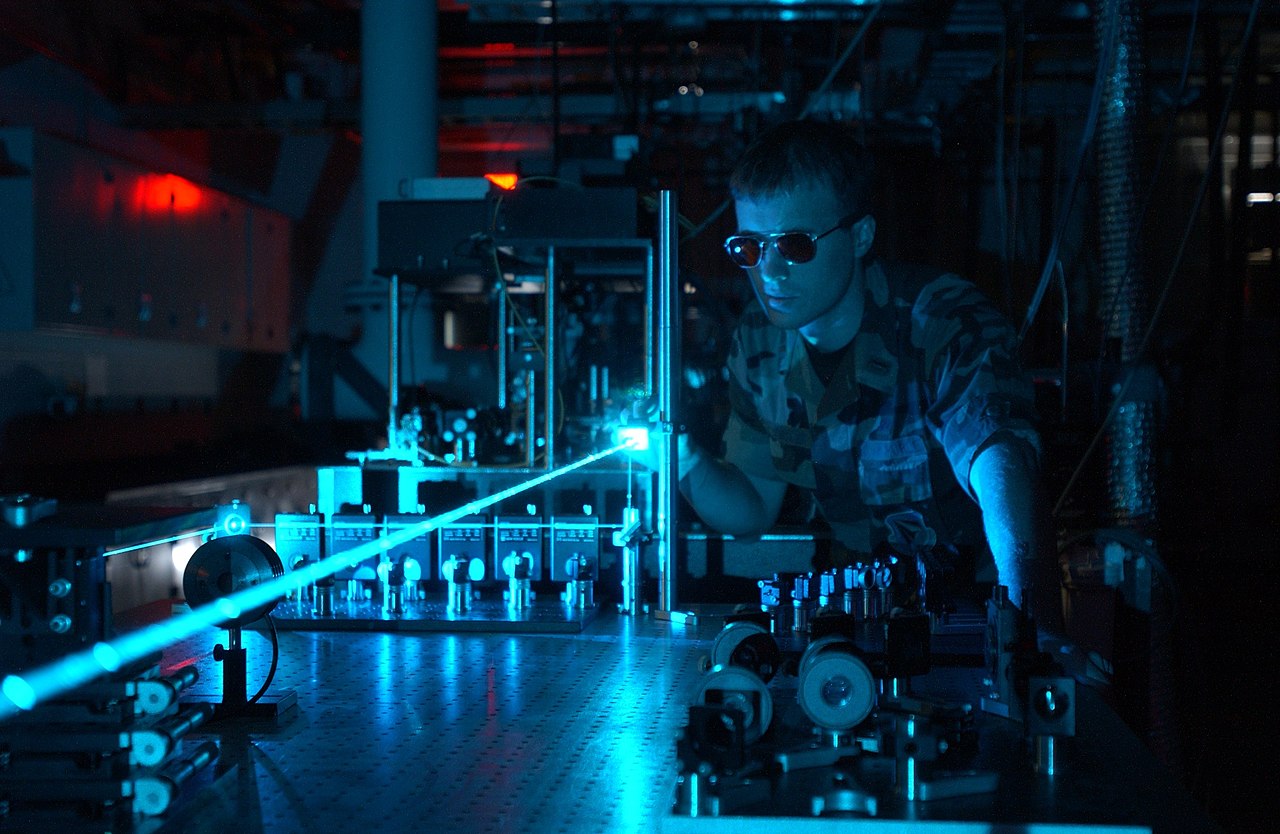
Source: paper, Section 1.
Waves can add up. Waves can cancel.
Drop two stones in a pond. Where ripples meet, they pile up or flatten out.
Light is a wave too.
Two waves in step add up to a height of 2.0. Two waves out of step add up to 0.0.
Background physics (interference). The paper builds on this effect in Section 3.1.
One particle can take two roads at once
A beam splitter gives a photon two fibres to pick from.
It does not pick. It uses both.
Physicists call this spatial-path superposition.
Source: paper, Section 3.1.
The link can be made during the trip
Old plan: make the entangled pair first, then ship it.
With two roads, the pair can form while the particle travels.
Making and shipping stop being two separate steps.
Source: paper, Section 3.1.
Two roads can cancel each other's noise
When the two roads meet again, their waves recombine.
For several kinds of noise, damage on one road is cancelled by the other.
This is not the usual error-correcting code. It comes from the waves themselves.
Source: paper, Section 3.1.
A normal address picks one house. A quantum address keeps two open.
Today an address points to one place.
A parcel on two roads is not in one place.
A quantum address holds both candidates until the moment one is needed.
Source: paper, Section 4. It adds to ordinary addresses and does not replace them.
Far-away cities can become next-door neighbors
Cables give the network its physical map.
Entanglement draws a second map on top.
Two nodes that share an entangled pair act as neighbors, even with other nodes between them. The cables are still needed to build that pair.
Source: paper, Section 3.2 and Figure 1.
The shortcut map redraws itself over time
An entangled link has a life.
It is made, shared, kept, reshaped and used up.
While it waits, it fades. So who counts as a neighbor changes with the clock.
Source: paper, Sections 2 and 3.2 (the paper writes this map as GE(t)). The fade curve shows the shape of the idea, not measured data.
Ordinary networking stays on the job
Ordinary signals still carry measurement results.
They still manage cables and lasers.
The new tools sit next to them, not in their place.
Source: paper, Sections 1, 4 and 5.
Carries and coordinates
Measurement results, link monitoring, the physical map.
Does the new tricks
Two-road travel, quantum addresses, links that depend on entanglement.
Three questions nobody has answered yet
Some pieces are worked out already, such as routing over entanglement-made links.
Routing a path that is still "both roads" is not worked out yet.
Source: paper, Section 5 and Table 1.
Routing
How do you pick a route when the path itself is still "both"?
Control
Which choices must stay quantum, and which can be ordinary?
Building blocks
How do you snap many quantum tools together without breaking what makes them work?
The network was a road. It may also be a machine.
For years, a quantum internet meant a delivery service.
This paper asks for more: let the physics help steer.
A particle on two roads. Noise that cancels itself. Neighbors the cables never joined.
Source: paper abstract and Section 5.
The parcel
The parcel
What came from where
Every idea about two roads, shared links and quantum addresses comes from the paper below.
Two things are ours: the wait-time arithmetic on slide 3 and the plain-language wave picture on slide 5.
Beyond Quantum Messages: Toward Quantum-Native Network Functioning
A. S. Cacciapuoti, J. Illiano, C. De Risi, M. Caleffi. arXiv:2611.08298v1, 5 Nov 2026.
Quantum internet architecture: unlocking quantum-native routing via quantum addressing
M. Caleffi and A. S. Cacciapuoti. IEEE TCOM, 2026. doi:10.1109/TCOMM.2025.3650397.
Photos from Wikimedia Commons: NTNU (CC BY 2.0), U.S. National Archives (no restrictions), US Air Force (public domain), Giorgio Brida (CC BY 2.0), Asurnipal (CC BY-SA 4.0). Links are on each slide. Funding named in the paper: European Research Council grant QNattyNet, no. 101169850. Reporting: Vizmaya desk, November 2026.