Geography of an epic
Tuonela, the Kalevala's land of the dead: what is there today
The short answer: the only mapped Tuonela we could verify is on Neptune's moon, Triton. On Earth, we found no site at all.
vizmaya desk · 15 October 2026
Geography of an epic
The short answer: the only mapped Tuonela we could verify is on Neptune's moon, Triton. On Earth, we found no site at all.
vizmaya desk · 15 October 2026
First, the book
The Kalevala is a long poem from Finland. One person did not write it. For centuries, ordinary people sang its verses aloud.
Then an editor, Elias Lönnrot, wrote down songs from singers in Karelia, Finland and Ingria. He joined them into one book. The first edition came out in 1835.
The version most people read today came out in 1849.
Lönnrot built the poem from oral songs. That matters for our question: its places come from singers, not from a surveyor.
Sources: Kalevala Society; Finnish government, 11 April 2024.
A fair warning
We started with a guess: most places in the Kalevala are symbolic. We tested it on one poem. For each place we ask how it is real.
We checked every place the poem visits, in order. None is given real-world coordinates.
Source: Poem 16, Finnish 1849 text and Crawford's 1888 English. Finnish text; Crawford.
Poem 16
Väinämöinen is a hero who works by singing. He is building a boat out of song. Near the end, three magic words are missing. Without them, the boat will not float.
He hunts for the words in birds, then in animals. He fails. So he decides the dead must know them.
Tuonela is the last place he tries, after everything on the living side fails.
Source: Poem 16, Finnish 1849 text and Crawford 1888. Crawford, Rune XVI.
The way in
In the poem, the land of the dead is reached on foot. The walk takes three weeks through thick brush.
Then an island and a mound come into view. A black river runs between him and them. He shouts for a boat, and a small girl rows him over.
The poem treats Tuonela like a far country with a river for a border.
Each step is described like a real trip. None of the steps is tied to a real map.
Source: Poem 16. Translators name the first two thickets differently, so we say only "thickets". Finnish text.
Inside
The queen, Tuonetar, offers him beer. He looks closer and sees frogspawn and snakes. He refuses.
She says he will never leave, and puts him to sleep. Her son stretches nets of iron and copper across the river.
Väinämöinen wakes, turns into a worm, and slips through. Back home, he asks that no living person ever follow.
The nets are there to keep a living man in. He gets out by changing shape.
Source: Poem 16. Crawford says a thousand nets. The Finnish says hundreds, even a thousand. Crawford, Rune XVI.
Text against ground
The poem describes a river, an island, a mound, houses, a ferry girl and nets.
It also uses four names for one realm: Tuonela, Manala, Tuoni and Mana. The word Tuonela can also just mean a grave or a graveyard.
We looked for a site, marker, map point or caretaker for Tuonela. We found none.
This is a finding about our search, not proof that nothing could exist. We did not search Finland's place-name archive.
Sources: Poem 16; Britannica, Manala; Wikipedia, Tuonela.
Who claims it
FactWe found no source that points to a real Tuonela on a map.
InterpretationScholars read it as an idea built on burial: graves, funeral shelters, island burial grounds, an afterlife under the ground and ringed by water.
OpenA 2012 Finnish book by Unto Salo has a section on archaeology and the Tuonelas of the poems. We confirmed it exists. We have not read it.
Parppeinvaara, in Ilomantsi, has a rune singer's cottage. The Ilomantsi Museum Foundation runs it. In summer it is open daily 11:00 to 17:00.
Source: Ilomantsi Museums. Position of Ilomantsi is approximate. Hours can change.
Off Earth
In 1991, the International Astronomical Union approved the name Tuonela Planitia. It is a flat plain on Triton, the largest moon of Neptune.
The US Geological Survey lists its origin as a Finnish underground realm across a black river.
It is the only place named Tuonela that we could verify on a map.
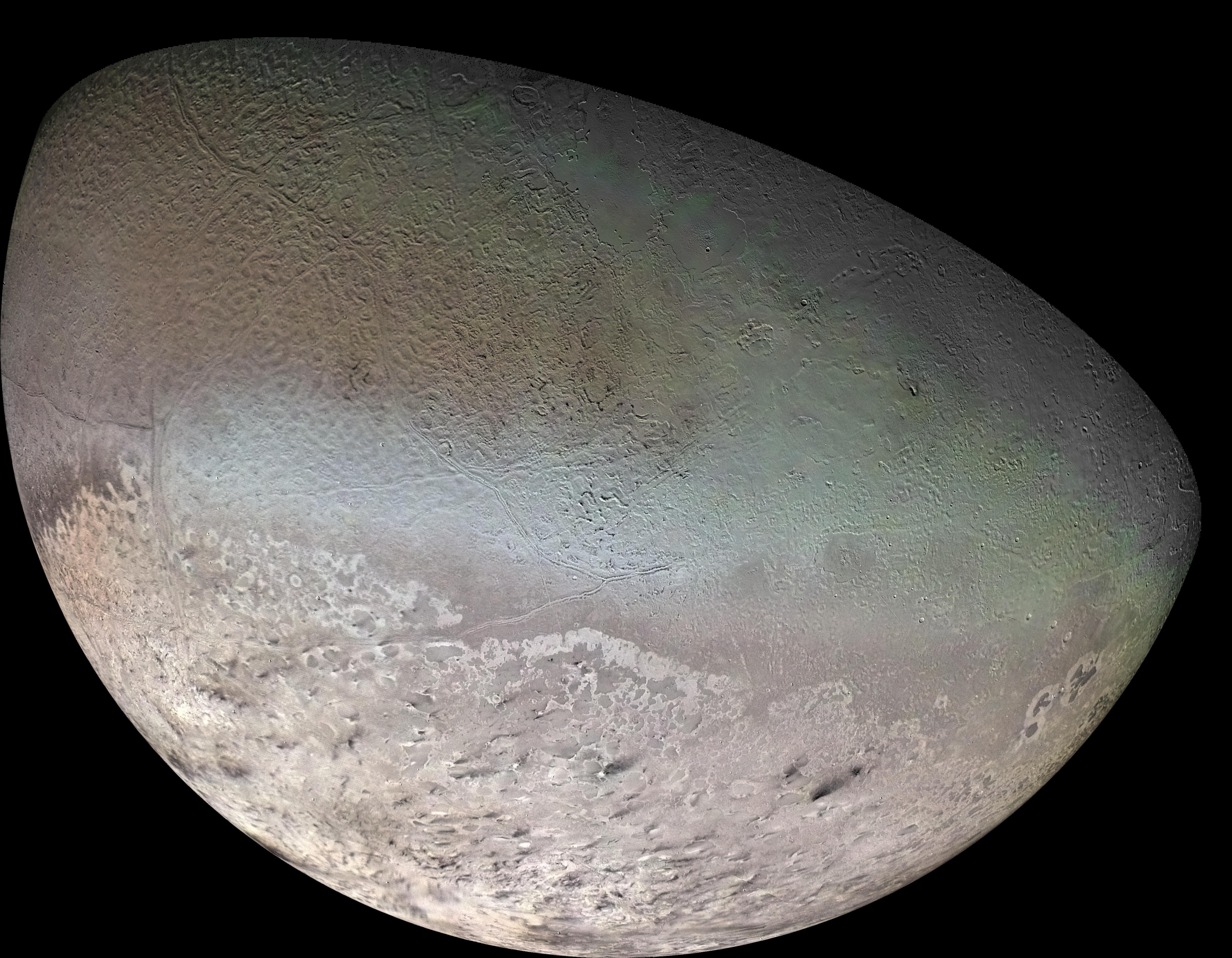
Triton is very cold, and most of its nitrogen is frozen as frost. We did not pin Tuonela Planitia on this picture.
Source: USGS Gazetteer of Planetary Nomenclature. It lists the plain at 34.0 and 14.5 degrees east, planetographic.
Heritage
In 2024, the European Commission gave the Kalevala the European Heritage Label, as a living epic. It is one of very few non-physical things to hold the label.
The Finnish Literature Society led the application with four partners, including the Parppeinvaara village.
The label names no Tuonela. It covers the tradition, not a site.
Each step keeps the poem alive. Not one of them marks a spot on Earth.
Sources: Sibelius works list; USGS; European Commission. Not to scale.
Gaps
The point
The only place named Tuonela that we could verify on any map is a plain on Neptune's moon Triton, named in 1991. On Earth, the 2024 Heritage Label protects the epic itself, not any place.
InterpretationThe land of the dead is kept by the people who keep singing it.
Sources
Images: Triton photo, NASA/JPL/USGS. The cover and all charts are original drawings by vizmaya desk, not evidence.
Sources and claims log
Contested: one site says this journey is in the 19th song, which three other sources contradict; the date of the label ceremony; and whether the poem's closing warning is original to the old songs.
More vizmaya stories: read the story archive.